Zürich Wants to Power Its Neighbourhoods with Rooftop Solar — But Hardly Anyone Is Selling
Thousands of residents have signed up to buy locally generated solar electricity. The problem is there is barely any to go around.
A quiet energy experiment is playing out across Zürich's residential streets, and it is revealing an unexpected bottleneck: not a lack of appetite for clean, locally sourced power, but a near-total shortage of people willing to produce it.
Since the start of this year, Swiss federal law has permitted homeowners with rooftop solar installations to sell their surplus electricity directly to neighbours, through a framework known as local electricity communities — LEGs in the German acronym. In Zürich, the city's utility provider EWZ acts as the intermediary, matching supply with demand and paying producers a fixed rate of 14 centimes per kilowatt-hour. Buyers pay no more than they would for standard grid electricity.
The concept has struck a chord. According to EWZ spokesperson Thöme Jeiziner, more than 5,000 households have expressed interest in receiving solar power sourced from their own neighbourhood. The infrastructure currently in place, however, can accommodate only around 3,200 customers across roughly 150 active communities. Demand, in other words, is running at more than one and a half times what the system can currently deliver.
85 Percent of Rooftops Are Sitting Idle
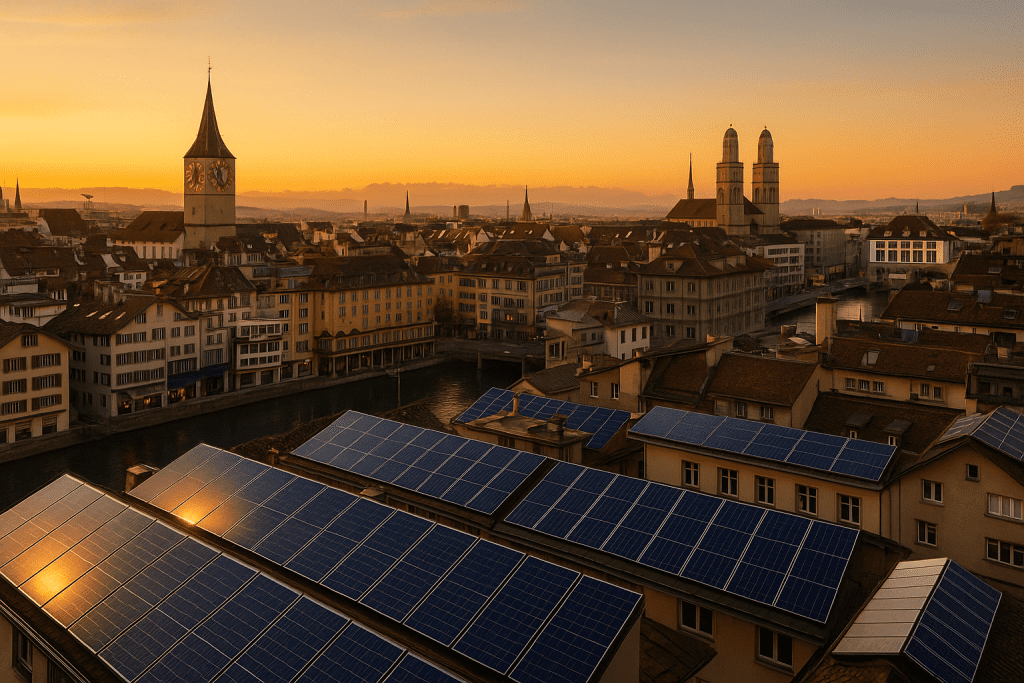
The constraint is not regulatory or technical — it is structural. The vast majority of Zürich's rooftops, around 85 percent, are privately owned, and their owners have yet to install panels. Without more producers joining the network, the pool of locally traded solar electricity cannot grow.
This is the gap the city is now trying to close. Starting in May, EWZ is launching a broad public campaign aimed squarely at private property owners, making the case that installing panels and selling power locally can be financially worthwhile. The utility is offering support across the entire process — planning, financing, installation and ongoing operation — and in some cases is prepared to cover both the upfront investment and running costs outright, asking only for access to the roof itself.
The push sits within a broader municipal target: to have solar installations account for 10 percent of the city's total electricity consumption by 2030. At present, the figure stands at 4 percent, leaving a considerable gap to close in under five years.
Whether a marketing campaign can shift the calculus for thousands of private landlords and homeowners remains to be seen. But for now, Zürich's solar neighbourhood vision is running well ahead of its own supply.
Report based on publicly available municipal energy data and statements from EWZ, Zürich, April 2026